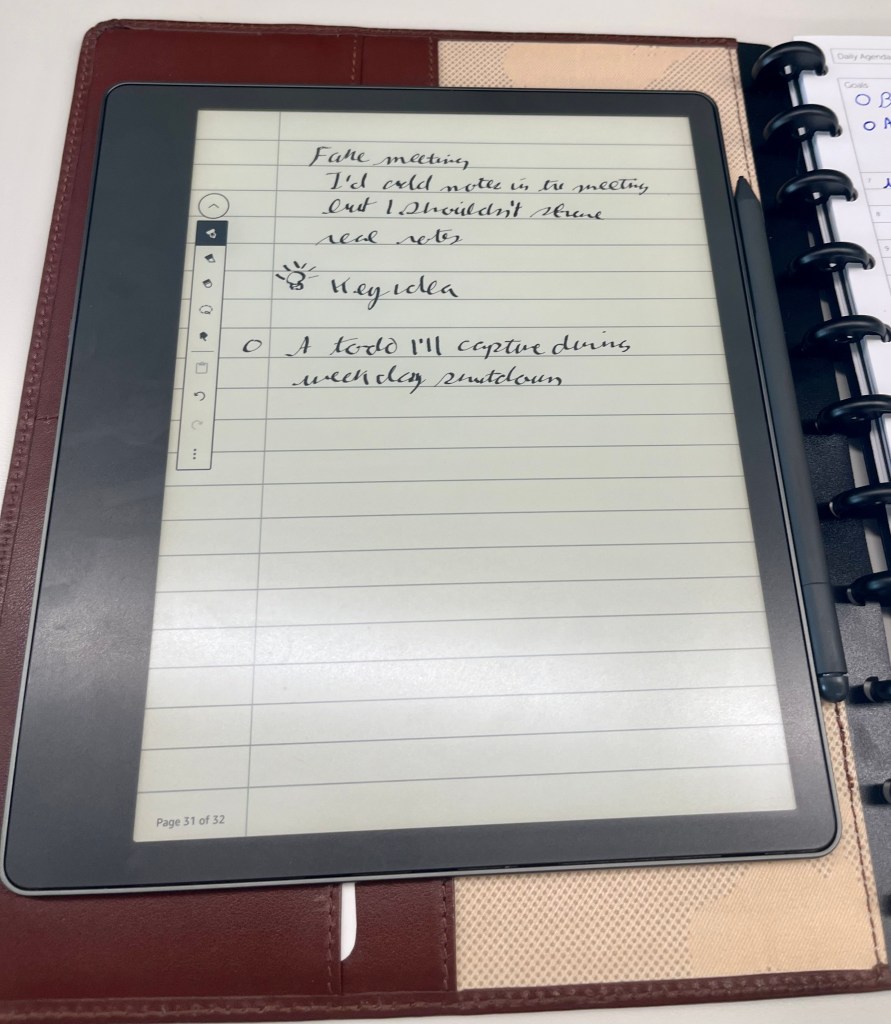
Even thought I have a shiny, new iPad Pro 12.9” wonder machine, I try not to use it in meetings.
Instead, I take notes hand, currently a Kindle Scribe. This is, perhaps not suprisingly, something I used to change up fairly often – because, even thought I know it’s not true, in my heart I think a Baron Fig or a Rhodia or dot grid or a travelers journal etc. will all somehow make me more organized, and better leverage my intentions. They won’t, but I like having tools I like to use. For a few month’s, that’s been the Scribe.
I do this for a few reasons:
Task Switching
It’s entirely possible I have ADHD, because all three of my kids have formal diagnoses and there’s a strong genetic component. It’s also entirely possible that I’ve just been on the internet too long, and need to stretch my focus muscles, as Cal Newport points out in both A World without email and Deep Work. Regardless, I find it hard not to tab over to outlook to check mail, to look up a point etc. I sometimes will use my iPad to pull up the presentation rather then use handouts – in that case, I find it useful to use the pencil and not the keyboard as it helps me stay more mono-task.
Active Listening
There’s a core, somewhat impertinent seeming question here – if I can read an email or do something else, particularly while people are talking about an area I know, why not do it? In deed, I think the pandemic has greatly increased people’s “multi-tasking”. WHile there may be some debate around whether people can multi-task (spoiler, they can’t) or are continuously jumping from thing to thing, I think there’s a deeper issue
Respect
One of the things that I’m working on as a leader is active listening – making sure that I am really listening to a person, and not jumping ahead to what I think they’re going to say, what my reply will be etc. This is actually quite hard for me, I’ve always been thinking a few steps ahead, which makes me talk fast, skip steps verbally etc. Handwriting slows me down, and it’s a clear sign that I’m listening. Since I’m summarizing and not transcribing, it makes me sure that I’m interpreting and processing what I’m hearing – and what I just wrote can be a great prompt for a summary statement or a follow up question, e.g. what I heard was “X, Y and Z”.
The faintest ink is better then the strongest memory?
There’s a body of research showing that we recall more when we hand write then when we type. I’ve also seen a number of quotes about how “the faintest ink is deeper then the strongest memory” or words to that effect. To be honest, this doesn’t matter for most meetings – I rarely go back and check notes in depth. I do process out next steps and occasionally review, but in most cases “I’m not writing it down to remember it later, I’m writing it down to remember it now”. I do find the act of handwriting helps me remember things now.
 Leveraged Intention